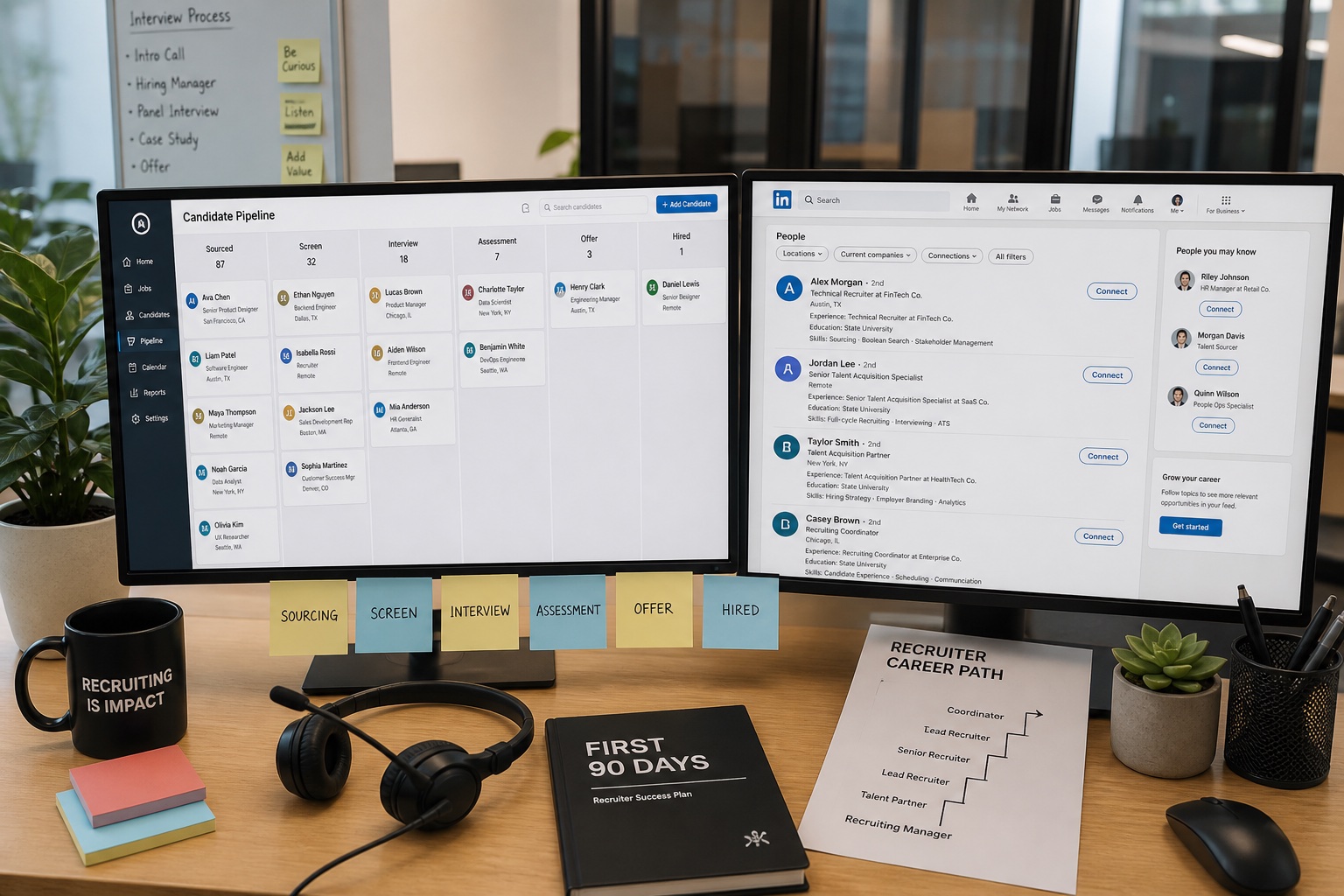
You do not need a mystical “people person” certificate to become a recruiter. You need a path into the work, a willingness to live in rejection and ambiguity, and a plan to learn sourcing, screening, and stakeholder management faster than the job burns you out.
Here is a practical map: entry routes, skills to build before the offer, agency vs corporate, and how to get good in year one.
Recruiting is a craft you enter through volume, then deepen with judgment.
What the job actually is
Before you chase the title, know the day: intake with hiring managers, sourcing and outreach, screens, scheduling chaos, offer negotiation, and endless follow-through. Sales DNA helps. Empathy without a spine does not. If you hate structured rejection and moving targets, pick another lane.
Common ways in
Path
How it works
Tradeoff
Agency / staffing desk
High volume, learn sourcing fast, commission pressure
Brutal hours; great training ground
Corporate coordinating / TA ops
Scheduling, ATS, candidate care into recruiter seat
Slower path; stronger process chops
HR generalist → recruiting
Lateral move once you know the company
May lack deep sourcing muscle at first
Industry specialist → recruiter
Engineer, nurse, seller who recruits their craft
Credibility high; must learn TA craft
Campus / early careers
Pipeline programs, events, high-volume grads
Narrower scope until you expand
RPO / outsourced TA
Client work with corporate tools
Variety depends on account
There is no single correct door. Agency teaches hunt. Corporate teaches systems. Specialists teach domain. Combine over a career.
Skills to build before you get the job
Writing under constraint. Cold outreach that is short, specific, and human.
Structured conversation. Practice screens: must-haves, motivation, comp, timeline.
Boolean basics. Title and skill queries on LinkedIn or job boards until it feels natural.
Pipeline hygiene. Spreadsheets or a free CRM habit: next step, owner, date.
Business curiosity. Can you explain how a company makes money in five sentences?
Emotional stamina. Rejection is the weather. Do not take every silence personally.
Optional but useful: a basic ATS familiarity (even sandbox videos), LinkedIn Recruiter demos, and one niche market you can speak about (healthcare, trades, SaaS, ops).
How to get the first seat
Resume: Show evidence of persuasion, organization, and targets hit (sales, customer success, campus leadership, military recruiting, HR support). Quantify.
Story: “I want to recruit because I like people” is weak. Prefer: “I like matching scarce skill to real business problems, and I can handle a no.”
Network: Message recruiters for 15-minute path chats. Ask what their first role was. Apply to coordinator and associate recruiter titles without shame. Those are real jobs.
Interview prep: Be ready for role-play screens, objection handling, and “how would you fill this req.” Bring a sample outreach note and a simple search string.
Your first recruiting resume should prove targets, writing, and follow-through, not vibes.
Agency vs corporate: pick with eyes open
Agency: Faster skill acquisition, clearer individual metrics, income upside, and grind. You will learn to source or leave.
Corporate: Deeper stakeholder work, brand and equity constraints, better hours at many companies, slower feedback loops. You will learn politics and process.
Many strong careers do agency first, corporate second. The reverse also works if you deliberately practice outbound.
Your first 90 days
Learn the ATS like a cockpit. Notes quality is reputation.
Shadow three intakes. Write the must-haves better than the JD.
Send real outreach daily. Track reply rate, not send vanity.
Close every loop you open. Follow-through is how juniors get trusted.
Ask for one metric owner: time-in-process or screens-to-onsite. Improve it.
Build a tiny market map: top companies, titles, and where people come from.
Certifications and degrees
A degree helps at some employers and is irrelevant at others. Certifications (HR or recruiting) rarely beat demonstrated sourcing and a clean process story. Do not delay entry for a badge unless a specific job requires it. Learn on live reqs.
Red flags in “recruiter” job posts
Unpaid “training” that is just lead gen
Unlimited req load with no coordinator support and fantasy targets
“Sales” jobs wearing a recruiting title with no candidate care
Companies that celebrate ghosting as speed
Ask about ramp, expected reqs per recruiter, and how success is measured in month three.
Growth path after you start
Associate → recruiter → senior → lead / manager, or specialist IC (technical, executive, diversity, talent research). Some move into TA ops, employer brand, or HRBP. Pick depth (own a craft market) or breadth (lead a team). Both are valid.
The pain
Becoming a recruiter is less about personality type and more about entering a feedback-heavy craft and staying long enough to get good. Recruiting Pains’ take: pick a door (agency, coordinator, specialist), build writing and Boolean before day one, treat follow-through as your brand, and measure learning by closed loops and honest screens, not by how many InMails you blasted.